Rail & manufacturing
Tank Car Sizing
A railcar sizing engine, ported from a Fortran 77 console program to the web
- Client
- Railcar manufacturer
- Engagement
- Surge, a Catalyte Company
- Role
- Sole developer
- Year
- 2015
- Platform
- Web application
- Project type
- Legacy port from Fortran 77
About the application
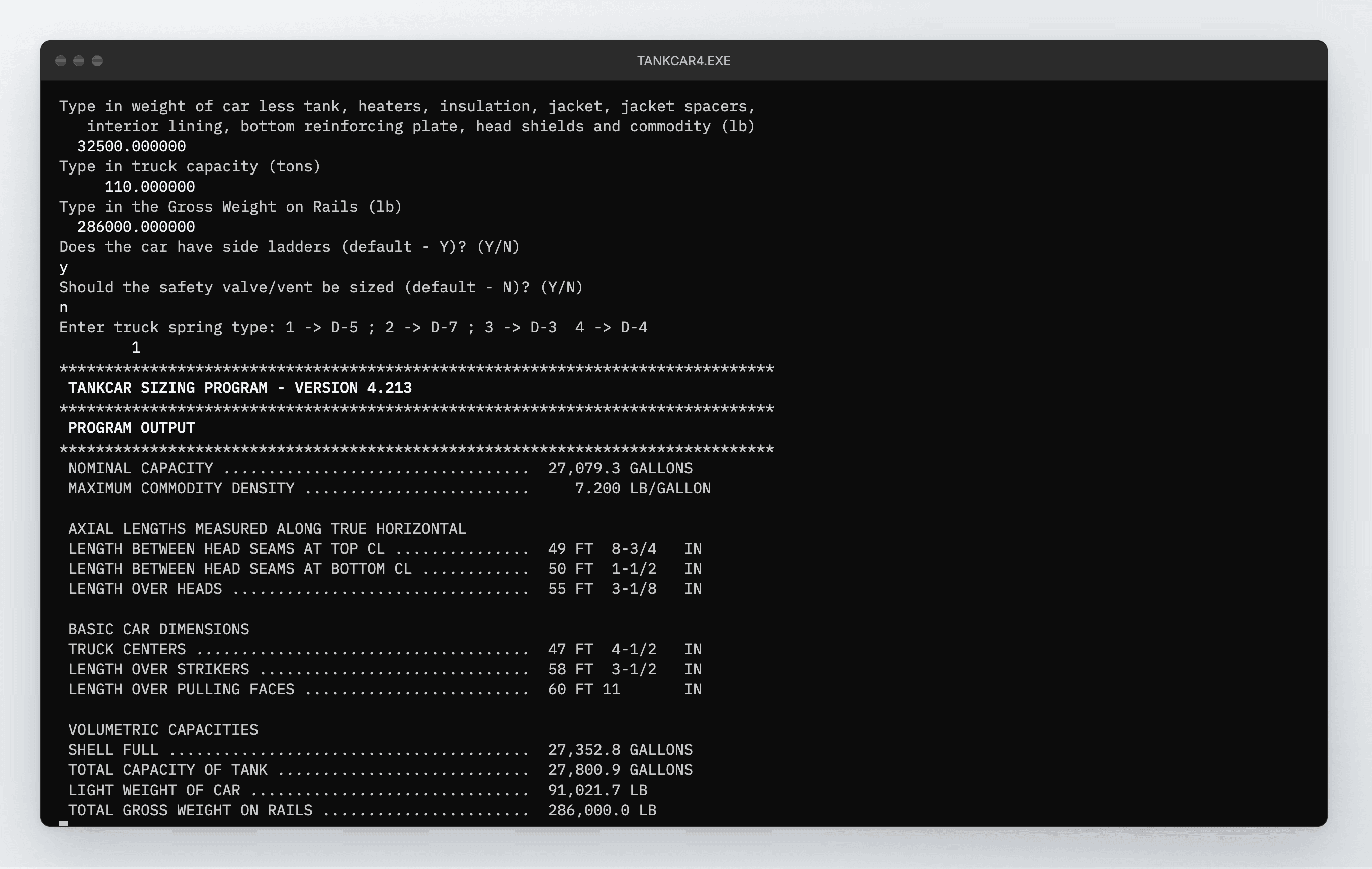
Before a tank car is built, its tank has to be sized: from the commodity it will carry, that commodity’s density, and the capacity or length the customer needs, engineers work out the tank’s dimensions, capacities, light weight, and gross weight on rails. At this railcar manufacturer, those numbers came from an 8,000-line Fortran 77 console program that engineers ran by answering prompts one line at a time.
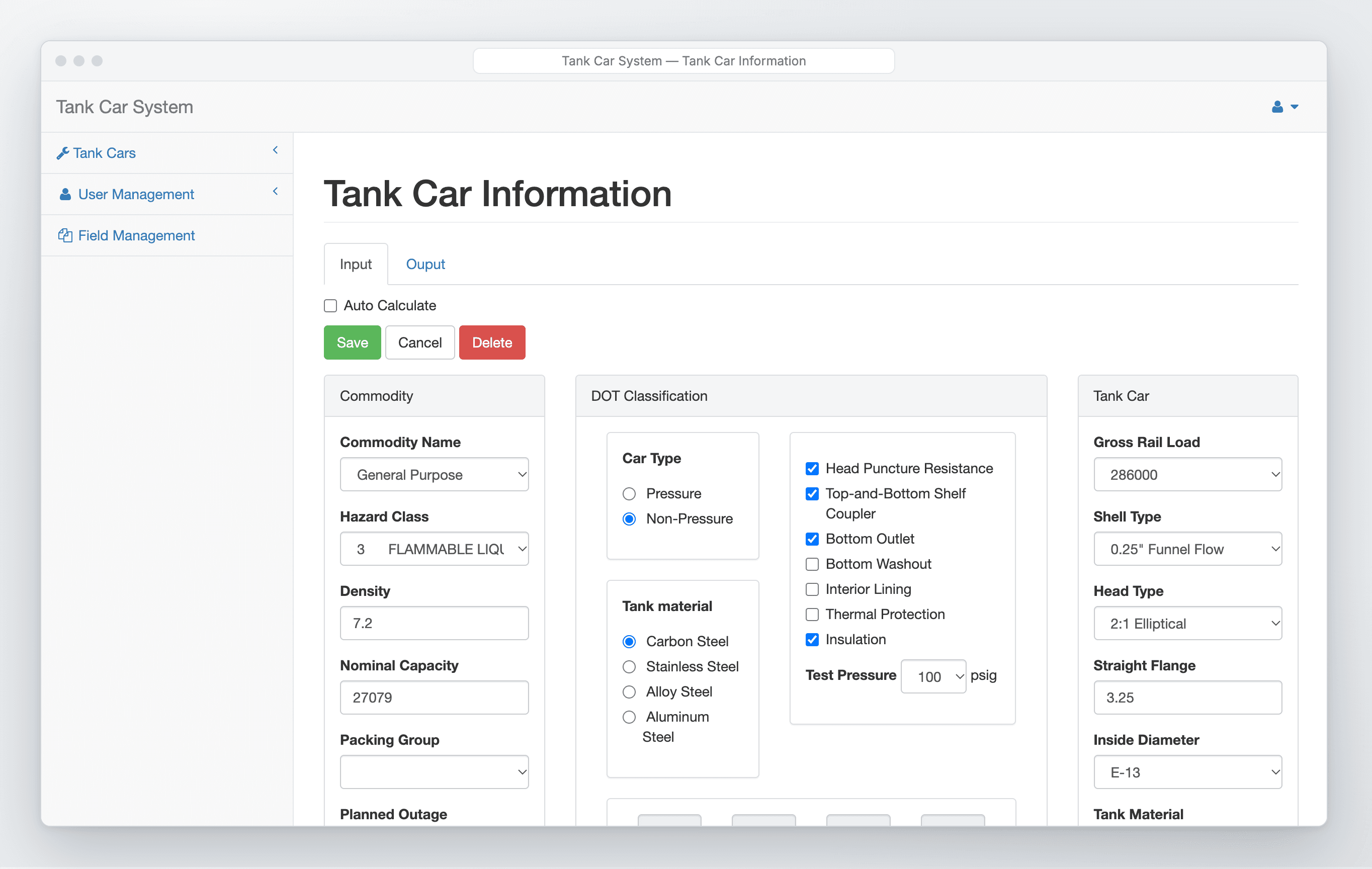
The port moved that sizing engine, which handles both funnel-flow and straight-shell cars and can size from required capacity, commodity density, or length over strikers, into C# behind a web application built on ASP.NET 4.5 Web API, Entity Framework, Breeze, and AngularJS. Engineers fill in a form instead of a console session and save their tank car designs.
Key features
- Sizes funnel-flow and straight-shell tank cars from required capacity, commodity density, or length over strikers
- Commodity inputs: name, hazard class, density, nominal capacity, packing group, and planned outage
- DOT classification: pressure or non-pressure car, tank material, test pressure, and options such as head puncture resistance, shelf couplers, bottom outlet, and insulation
- Tank car inputs: gross rail load, shell type, head type, straight flange, inside diameter, and tank material
- Separate Input and Output tabs, with an optional auto-calculate
- Saved tank car designs, plus user management and field management screens
Responsibilities
- Sole developer on the port, from requirements through delivery.
- Ported the 8,000-line Fortran 77 sizing program to C#, keeping its calculations intact.
- Built the ASP.NET 4.5 Web API back end with Entity Framework.
- Built the AngularJS front end, with Breeze for client-side data management and a Bootstrap UI.
- Added what the console program never had: saved designs, user management, and field management.
What the modernized version changes
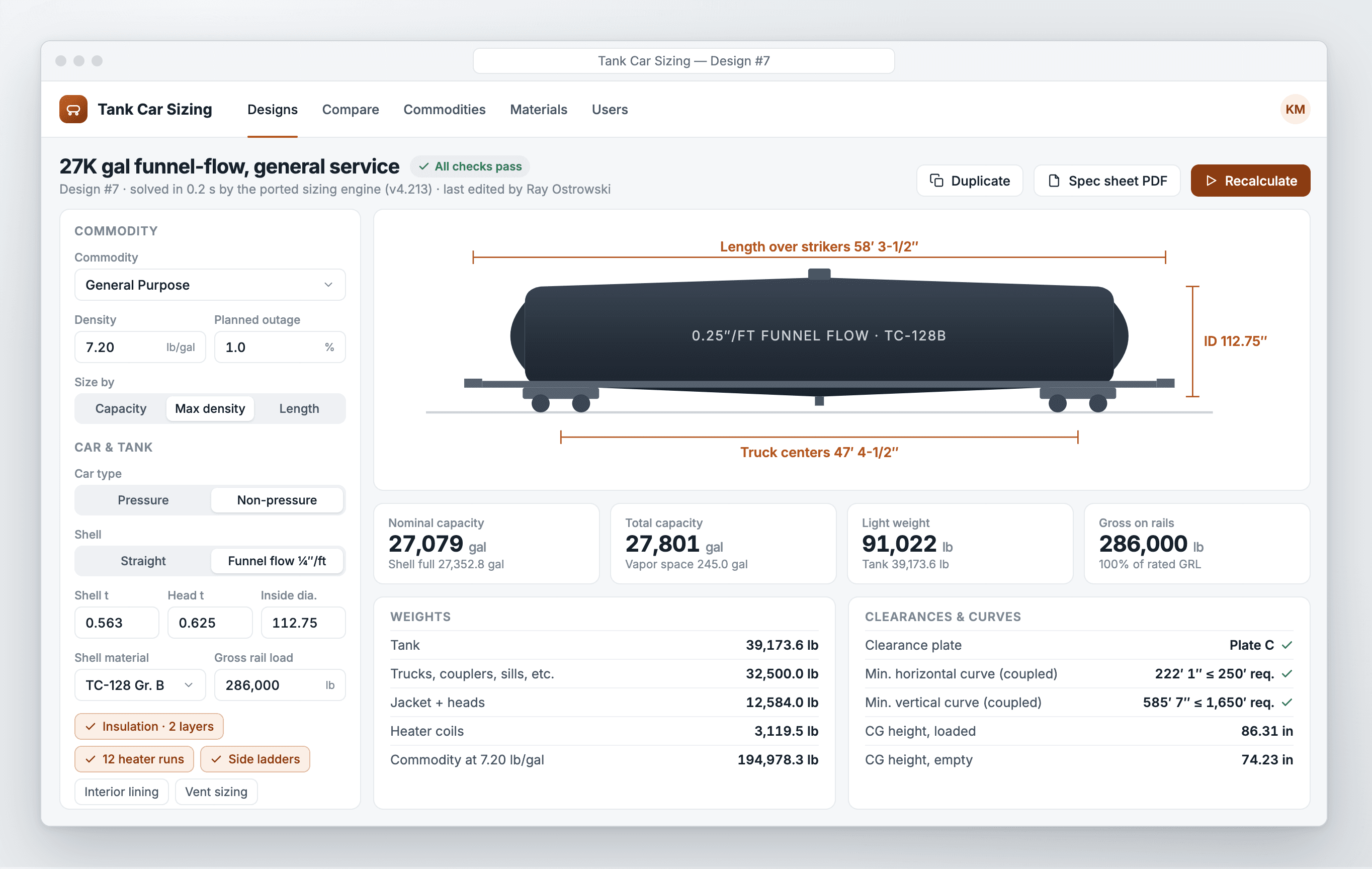
- Inputs, live results, and a dimensioned drawing of the car share one screen instead of separate Input and Output tabs.
- Size by capacity, max density, or length with a single switch.
- Headline results as cards: nominal capacity, total capacity, light weight, and gross weight on rails.
- Weight breakdown and clearance and curve checks, each with a pass mark and an overall “All checks pass” status.
- Designs can be compared, duplicated, and exported as a spec-sheet PDF.
Still running on a system like this?
We modernize legacy desktop and WebForms apps without losing the workflows your team depends on.